
Thread is for any topic in mathematics. Difficulty and technicality unbounded, post your problems, solutions to problems, questions, etc. regardless if they're "too easy" or actually really hard! (Although some problems can unequivocally be considered "too easy", e.g. (and inb4) 2+2.)
:)
Found this fun and easy proposition while scrolling through a textbook, try proving it.
Proposition: The square of an odd integer greater than 1 is of the form 8n+1 for some positive integer n.
Proposition: The square of an odd integer greater than 1 is of the form 8n+1 for some positive integer n.
:)
Deleted User
just found out you can make diamonds (45 degree angle square not the glittery ones) w the function a = sqrt(x^2) + sqrt(y^2), a being the length between corners
The natural number game: https://www.ma.imperial.ac.uk/~buzzard/xena/natural_number_game
A very cute game that involves proving the properties of the natural numbers (e.g., associativity and commutativity of addition and multiplication) from the Peano Axioms.
If you've done enough (informal) proofs, I think this will make you think about proofs a little bit differently as it did for me.
A very cute game that involves proving the properties of the natural numbers (e.g., associativity and commutativity of addition and multiplication) from the Peano Axioms.
If you've done enough (informal) proofs, I think this will make you think about proofs a little bit differently as it did for me.
:)

Pecfex: Proposition: The square of an odd integer greater than 1 is of the form 8n+1 for some positive integer n.
Should I ask this to my math enthusiast teacher for lulz?
Recently, my focus has entirely been on algebra. I found that it's the only part of math that I find natural to think about so far---unlike analysis or topology. I've been reading mostly two books, Algebra by Michael Artin (a well-known mathematician who works in algebraic geometry), and Ideals, Varieties, and Algorithms by David Cox, John Little, and Donal O'Shea. I really like both of the books, and I find the second book in particular very accessible.
The first book begins with matrix operations, laying down the motivation for studying them, the rules of matrix manipulation, and some methods like row reduction and cramer's rule. The second chapter I think is where it begins the journey into abstract algebra proper, starting with groups. From as much as I've read, the book takes group structure as a "basic" structure and introduces other more "complicated" structures like fields and rings as "groups with extra structure" but it doesn't introduce any structures more "basic" than groups, like monoids, for instance. Out of the first 9 chapters, 5 chapters are directly concerned with groups. The last 5 chapters of the book touch on---all in this order---rings, factorisation, modules, fields, and---finally the big payoff---galois theory.
The book has ample exercise sets at the end of every chapter. Personally, I'm leaving a great majority of the exercises untouched and only plan to return to the exercises later on successive read-throughs. Some exercises marked with asterisks are worth spending your time on. The preface says "Some acquaintance with proofs is obviously useful, though less essential." But personally, I think it's better in any case to have become comfortable with proofs before you read this book.
I haven't read much of the second book, only the first chapter, but my first impression is that it's very readable. I think that's the intended purpose; I think the authors wanted the book to be fairly accessible to undergraduates. Maybe it's no wonder that the book won the Leroy P. Steele Prize for Mathematical Exposition in 2016. As the title suggests, this book takes a computational approach to algebraic geometry and commutative algebra. There's a total of 9 chapters and 4 appendices. As for prerequisites, the preface says the reader "should have had a course in linear algebra and a course where they learned how to do proofs." Knowledge of abstract algebra is not a strict prerequisite but some exercises do require it, and knowing abstract algebra would let you go over some sections of the book faster.
Here's for information about the second book: https://dacox.people.amherst.edu/iva.html
The first book begins with matrix operations, laying down the motivation for studying them, the rules of matrix manipulation, and some methods like row reduction and cramer's rule. The second chapter I think is where it begins the journey into abstract algebra proper, starting with groups. From as much as I've read, the book takes group structure as a "basic" structure and introduces other more "complicated" structures like fields and rings as "groups with extra structure" but it doesn't introduce any structures more "basic" than groups, like monoids, for instance. Out of the first 9 chapters, 5 chapters are directly concerned with groups. The last 5 chapters of the book touch on---all in this order---rings, factorisation, modules, fields, and---finally the big payoff---galois theory.
The book has ample exercise sets at the end of every chapter. Personally, I'm leaving a great majority of the exercises untouched and only plan to return to the exercises later on successive read-throughs. Some exercises marked with asterisks are worth spending your time on. The preface says "Some acquaintance with proofs is obviously useful, though less essential." But personally, I think it's better in any case to have become comfortable with proofs before you read this book.
I haven't read much of the second book, only the first chapter, but my first impression is that it's very readable. I think that's the intended purpose; I think the authors wanted the book to be fairly accessible to undergraduates. Maybe it's no wonder that the book won the Leroy P. Steele Prize for Mathematical Exposition in 2016. As the title suggests, this book takes a computational approach to algebraic geometry and commutative algebra. There's a total of 9 chapters and 4 appendices. As for prerequisites, the preface says the reader "should have had a course in linear algebra and a course where they learned how to do proofs." Knowledge of abstract algebra is not a strict prerequisite but some exercises do require it, and knowing abstract algebra would let you go over some sections of the book faster.
Here's for information about the second book: https://dacox.people.amherst.edu/iva.html
:)
Here's one of the results I recently learned with a simple but clever proof. This is from chapter 2, section 1, ex. 5 of Ideals, Varieties, and Algorithms but a similar exercise is also in chapter 3, misc., ex. 8 in Artin's Algebra. 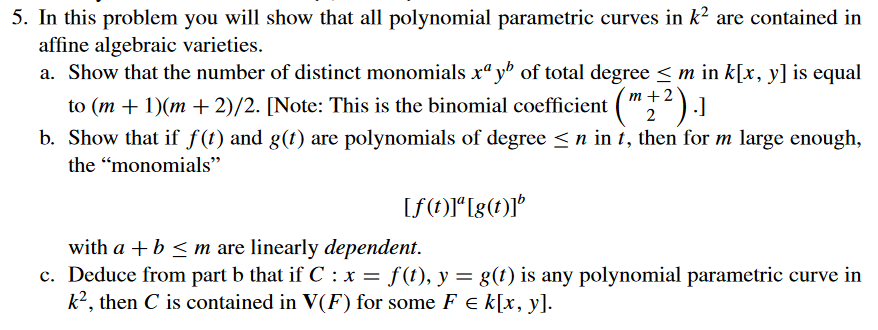 I thought it was really clever how this problem seemed stupidly complicated until you start thinking in terms of vector spaces. Then the problem decomposes very naturally. It's made me appreciate abstraction.
:)